
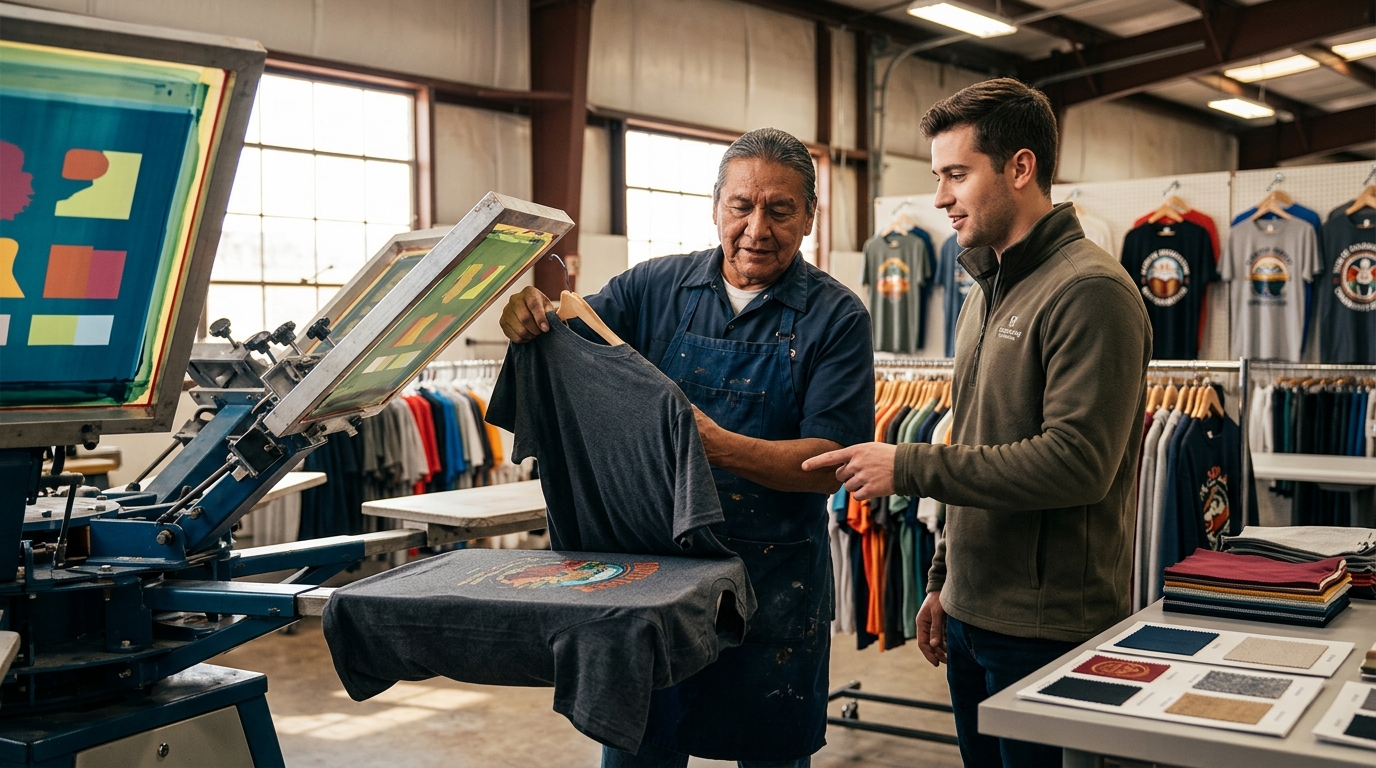
The global custom apparel market is projected to reach significant valuation milestones in the coming years, driven by the rising demand for personalized merchandise and corporate branding. Industry reports indicate that businesses and organizations increasingly rely on high-quality custom apparel to boost visibility and team cohesion. Understanding the technical differences between printing methods is essential for making cost-effective decisions that align with your brand's visual identity and budget constraints. (About Skyy Screen Printing)
Screen Printing: The Bulk Order Standard
Screen printing remains the most widely used method for large-scale custom apparel production. This technique involves pushing ink through a fine mesh screen to transfer an image onto the fabric. The result is a durable, vibrant print that withstands numerous wash cycles without fading. (Bulk Custom T Shirt)
How It Works
Screen printing is a multi-step process. First, a separate screen is created for each color in the design. The ink is then applied to the screen and squeegeed onto the garment. Each color layer must be cured with heat before the next color is applied. This method requires significant setup time, which makes it less efficient for small orders but highly cost-effective for bulk quantities. (Merch Apparel Resources from)
Best Use Cases
Screen printing is ideal for orders exceeding 24 pieces. It offers the lowest cost per unit at high volumes. The method supports a wide range of ink types, including plastisol, water-based, and specialty inks like metallic or glow-in-the-dark. Printing industry experts note that screen printing provides the most opaque coverage on dark garments, ensuring brand colors appear true to the original design.
Pros and Cons
The primary advantage is durability and cost efficiency for large runs. However, the setup costs and minimum order quantities can be prohibitive for small businesses or one-off events. Additionally, screen printing struggles with highly detailed gradients or photographic images.
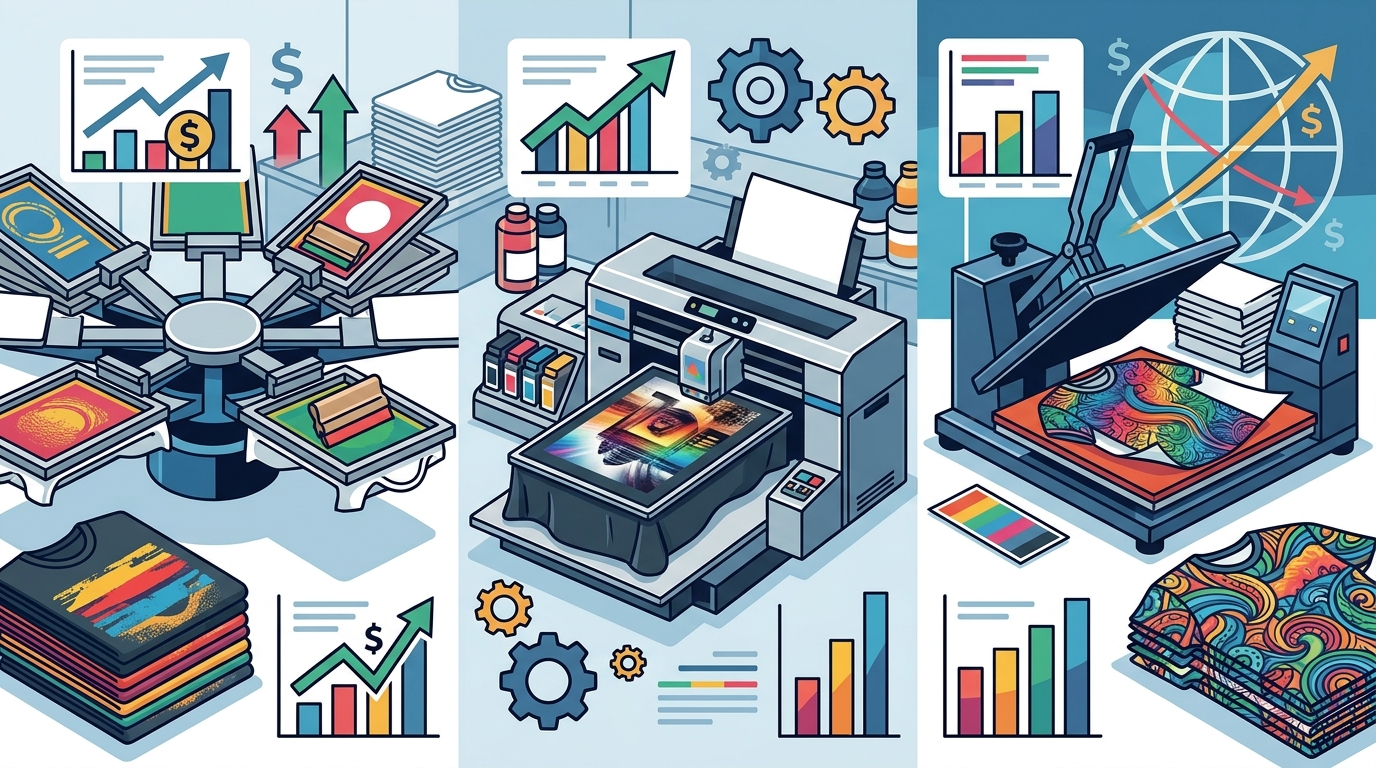
Direct-to-Garment (DTG): Detail and Complexity
Direct-to-Garment printing functions similarly to a standard office inkjet printer but uses specialized textile inks. DTG is a digital printing method that sprays water-based inks directly onto the fabric surface. This allows for unlimited color complexity without additional setup fees.
How It Works
DTG is a digital process. The design file is sent directly to the printer, which applies the ink layer by layer. A pre-treatment liquid is often applied to cotton garments to ensure the ink bonds properly and remains vibrant. The garment is then cured using a heat press or conveyor dryer.
Best Use Cases
DTG is perfect for small orders, single pieces, or designs with complex gradients and photorealistic details. It eliminates the need for screens, making it cost-effective for low-volume runs. Business growth analyses suggest that DTG enables rapid prototyping and on-demand production, reducing inventory waste for startups and small businesses.
Pros and Cons
The main benefit is the ability to print intricate designs with no minimum order quantity. However, DTG can be more expensive per unit for large orders. It also works best on 100% cotton garments; polyester blends may require special pretreatment or yield less vibrant results.
Sublimation: Vibrant, All-Over Designs
Sublimation is a digital printing technique that uses heat to transfer dye onto materials. The ink turns into a gas under high heat and pressure, bonding with the fibers of the fabric. This process results in a print that is part of the fabric itself, rather than sitting on top of it.
How It Works
Sublimation requires a special polyester-coated substrate or 100% polyester garment. The design is printed onto transfer paper using sublimation inks. The paper is then placed on the garment and heated in a press. The heat causes the ink to sublimate, penetrating the fabric fibers. Technical guides confirm that this method prevents cracking, peeling, or fading because the dye becomes part of the material.
Best Use Cases
Sublimation is ideal for all-over prints, sportswear, and items requiring vibrant, edge-to-edge designs. It works exclusively on polyester or polymer-coated surfaces. It is not suitable for cotton garments unless they have a special coating.
Pros and Cons
The advantage is the vibrant, durable, and breathable print quality. It allows for complex, full-color designs without color limits. The limitation is the material restriction; it cannot be used on natural fibers like cotton or wool without specialized coatings.
Method Comparison Matrix
Choosing the right printing method depends on your order volume, design complexity, and fabric type. The following table summarizes the key differences between screen printing, DTG, and sublimation.
| Feature | Screen Printing | Direct-to-Garment (DTG) | Sublimation |
|---|---|---|---|
| Best For | Bulk orders (24+ units) | Small orders, detailed designs | Polyester, all-over prints |
| Cost Efficiency | Low cost per unit at high volume | Higher cost per unit, no setup fee | Competitive for polyester items |
| Design Complexity | Limited by color count | Unlimited colors, photorealistic | Unlimited colors, vibrant |
| Fabric Type | Cotton, Polyester, Blends | Primarily 100% Cotton | 100% Polyester or Coated |
| Durability | High, withstands many washes | Good, but may fade over time | Extremely high, dye-infused |
Key Takeaways
- Screen Printing is the industry standard for bulk orders, offering the best cost-per-unit ratio for quantities over 24 pieces.
- Direct-to-Garment (DTG) eliminates setup fees, making it ideal for small batches and complex, multi-color designs on cotton.
- Sublimation provides vibrant, all-over prints that never crack or peel, but is restricted to polyester or polymer-coated fabrics.
- Native American-owned businesses like Skyy Screen Printing bring specialized expertise and cultural commitment to custom apparel production.
- Free Nationwide Shipping is available for bulk orders across the contiguous United States, reducing logistical costs for remote clients.
- Turnaround Time varies by method; screen printing requires setup time, while DTG and sublimation offer faster digital processing.
- Design Preparation is critical; high-resolution vector files ensure the best results for screen printing, while DTG accepts detailed raster images.
Frequently Asked Questions
What is the minimum order quantity for screen printing?
Screen printing typically requires a minimum order of 24 pieces to justify the setup costs for screens and ink mixing. However, some providers may offer lower minimums for an additional fee.
Can I print on dark shirts with DTG?
Yes, DTG can print on dark shirts, but it requires a white ink underbase. This can sometimes result in a slightly stiffer feel compared to screen printing on light garments.
Is sublimation suitable for cotton shirts?
No, sublimation ink bonds with polyester fibers. It will not adhere to 100% cotton. For cotton, screen printing or DTG are the appropriate choices.
How long does custom printing take?
Turnaround time depends on the method and order size. Screen printing may take 5-7 business days for setup and production, while DTG can be completed in 1-3 business days for smaller orders.
What file formats do you accept for custom designs?
We accept high-resolution vector files such as AI, EPS, and PDF for screen printing. For DTG, high-resolution PNG or JPG files are suitable.
Do you offer free shipping?
Yes, we offer free shipping across the contiguous United States for bulk orders, making it easier to distribute custom apparel nationwide.
Can you help with artwork design?
Absolutely. Our in-house design team can assist with creating or refining your artwork to ensure it is optimized for your chosen printing method.
Start Your Custom Order
Ready to bring your vision to life? Whether you need bulk corporate apparel, event t-shirts, or custom merchandise, Skyy Screen Printing is here to help. As a Native American-owned company with over 20 years of experience, we combine traditional craftsmanship with modern efficiency. Request a free quote today and experience the difference of working with a dedicated custom printing partner.